- Home
- Attractions
- Observatorio Del Teide
Observatorio del Teide - an important professional installation
that I'm associated with.
Learn more
The Observatorio del Teide, or Observatory of Teide, is regarded as one of the most important observatories in the world. Inaugurated in 1964, its position up in the mountains of Tenerife assures crystal clear skies for optical telescopes and it is especially suited to study of the Sun. It currently houses some of Europe's main solar telescopes.
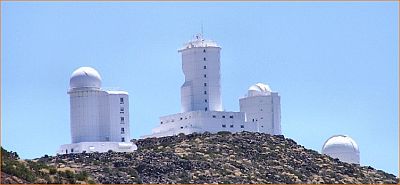
Photo: Besnier.m
There is a bewildering array of different telescopes, some affiliated to different countries and universities.
- Telescopio Carloz Sanchez
Named after the one-time Professor of Astrophysics at the University of La Laguna. He specialised in infra red astronomy and this telescope is used in this discipline. - Optical Ground Station
Installed by the European Space Agency, this focusses on, amongst other things, keeping track of space debris, as well as general astronomical research. - IAC-80
A small telescope, ideal for long-term observations. - Stellar Astrophysics and Research on Exoplanets
Known, for short, as "STARE", one of its functions is to search out and study "exoplanets" (planets orbiting stars other than the Sun). - CMB
Standing for "cosmic microwave background", this telescope studies this phenomenon, which results in vital information about the origins of the Universe. - GREGOR
A relatively new, German built and controlled solar telescope, dedicated to observation of Earth's nearest star. - THEMIS
A joint venture by France and Italy, the acronym stands for Télescope Héliographique pour l'Etude du Magnétisme et des Instabilités Solairesand is also a solar telescope studying the Sun. It is the third largest of its kind in the world. - VTT
The "Vacuum Tower Telescope" is another telescope operated by German astronomical institutes, dedicated to studying the Sun. - Mons
A reflecting telescope operated by the University of Mons, in Belgium. - Bradford Robotic Telescope
An optical telescope operated by the University of Bradford, UK, much used for educational purposes. - STELLA
Telescopes observing stellar activity and operated by the Astrophysical Institute of Potsdam. - SolarLab
A small collection of six installations concerned primarily with studying the interior of the Sun (a discipline known as "helioseismology").
| As you can see from the above, the Observatorio del Teide is a serious installation used by professional astronomers undertaking important research, but, fear not, part of it is open to the public, under strict conditions. Visits may only be made between the months of April and December. Visits may only take place during daylight hours. A minimum of fifteen visitors at a time is required. Visitors are required to fill in an application form. Visits may be cancelled due to weather conditions. Any visitors wishing to use the Mons telescope during their visit must make a request for this in advance. | 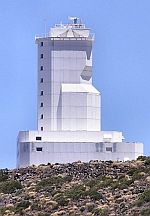 Photo: Besnier.m |
Photo: Besnier.m
As you can see from the above, the Observatorio del Teide is a serious installation used by professional astronomers undertaking important research, but, fear not, part of it is open to the public, under strict conditions. Visits may only be made between the months of April and December. Visits may only take place during daylight hours. A minimum of fifteen visitors at a time is required. Visitors are required to fill in an application form. Visits may be cancelled due to weather conditions. Any visitors wishing to use the Mons telescope during their visit must make a request for this in advance.
contact details:
Telephone: (+34) 922 329110
Email: teide@iac.es
Website: www.iac.es/eno.php?op1=3&lang=en
To get to the Observatorio del Teide, you need to be on the TF-24 mountain road. From the north, this goes directly from La Laguna.
From the south, take the TF-1 motorway, exiting at junction 11 (Guimar). This will put you onto the TF-61 to Guimar at which point you turn right (just before a Shell petrol station). Now you are on TF-28 and you need to turn off this, to the left (watch out for a small sign saying "Piramides de Guimar").
This is now TF-525 and you should stay on it. It eventually turns into TF-523 and now it becomes very winding as it takes you up into the mountains. It finishes at a junction with the TF-24, where you should turn left.
This road will take you to the road to the Observatory, turning off to the left.
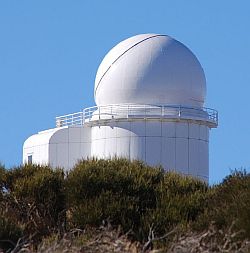
THEMIS
Photo: Taxiarchos228


|
Check out my other site |
|
Check out the TIC's thoughts for the week here |

  follow the TIC on X  your ad here! Become a site sponsor and have your ad appear on every page. More info.  web business!  Accommodation  Eating Out  Attractions  Villas  Tell me all your Tenerife experiences |

Facebook Comments
Have your say about what you just read! Leave me a comment in the box below.